
“The Rise of the Super Rhônes”: World’s First PanAsia Super Rhône Tour
Context: It was a first for me, a month-long round-the-world tour which was pretty hard-core even by my standards of perpetual motion! After a week in the US, I flew to China for a trip put together by our main Asian importer, Sarment. From there I was off on a solo jaunt to balmy Bali to preview the wines which will be landing there shortly, and then to Tokyo to participate in the Bettane-Desseauve Grand Tasting wine show, which teamed up with behemoth importer Pieroth (4500 visitors in 3 days!).In China, we were thrilled to show our wines alongside the iconic Trevallon and cult wine Roc d’Anglade during this very first voyage of its kind. The trip began in bustling Beijing, with high-level well-attended trade, press and private client lunches, followed by chic Shanghai, hyperactive Hong Kong then sultry Singapore.[gallery ids="1836,1749,1751,1771,1752,1750,1755,1840" type="rectangular" link="none"]
Terroir vs Appellation
The purpose of the Super Rhône tour was to showcase the producers from the Rhône Valley who are not (or who are no longer) completely affiliated with the appellation system, at least not for their top wines, but who are nonetheless perceived as punching above their weight.In this case, the Rhône Valley is defined by geography (ie. proximity to the river) and not appellation. This is a similar-but-different way of defining terroir, going back to the source, and doesn’t always match up with the established subdivisions. In some cases, like ours, the wines are already considered part of the Rhône wine region (despite the whole wine estate being located officially in the province of Provence on the administrative map of France), in others it often doesn’t correspond to the wine appellation map. Case in point: Trevallon, 7km from the Rhône but further south, which is part of the Provence wine region. Where does this leave the poor consumer? Lost and confused?This mismatch between Terroir and Appellation, more frequent in the South of France than in carefully thought-through and delineated areas such as Bordeaux and Burgundy, has frustrated certain winemakers, convinced, for objective and/or subjective reasons, that their terroir is best suited for other things in terms of quality or style. It has led a handful or two of us to take matters into our own hands and step out of the appellation when we feel our whole vineyard, single plot or individual cuvée would benefit.This brings with it significant consequences, such as having to go it alone for much of the promotion of the wines (otherwise typically aided by local wine syndicates), as well as other liabilities in the trade, such as not fitting neatly into a typical old-world wine list format. It also brings about increased responsibilities in disclosure and best practices, as (rightfully) the appellation and Customs watchdogs will scrutinise practices more carefully. Pricing is also a challenge, as it typically no longer reflects the averages that local producers set by tradition and appellation, and is rather a composite of critics’ opinions, market-driven scarcity, reputation, and cost of production. The decision is not for the faint of heart, and in my opinion should not be undertaken unless at least 3 of these Fantastic Four are in the mix.Conversely, the big advantage is that it allows more freedom of expression to the winemaker: which grapes to plant (often varieties not supported by the traditions or by-laws of the appellation, be the “international varieties” such as Cabernet or indigenous ones from other regions), where and when to harvest them, how to blend them, etc. Consequently these factors can turn out to be the most defining aspects of the quality and reputation of a Domaine.
Birth of the first Super Rhône
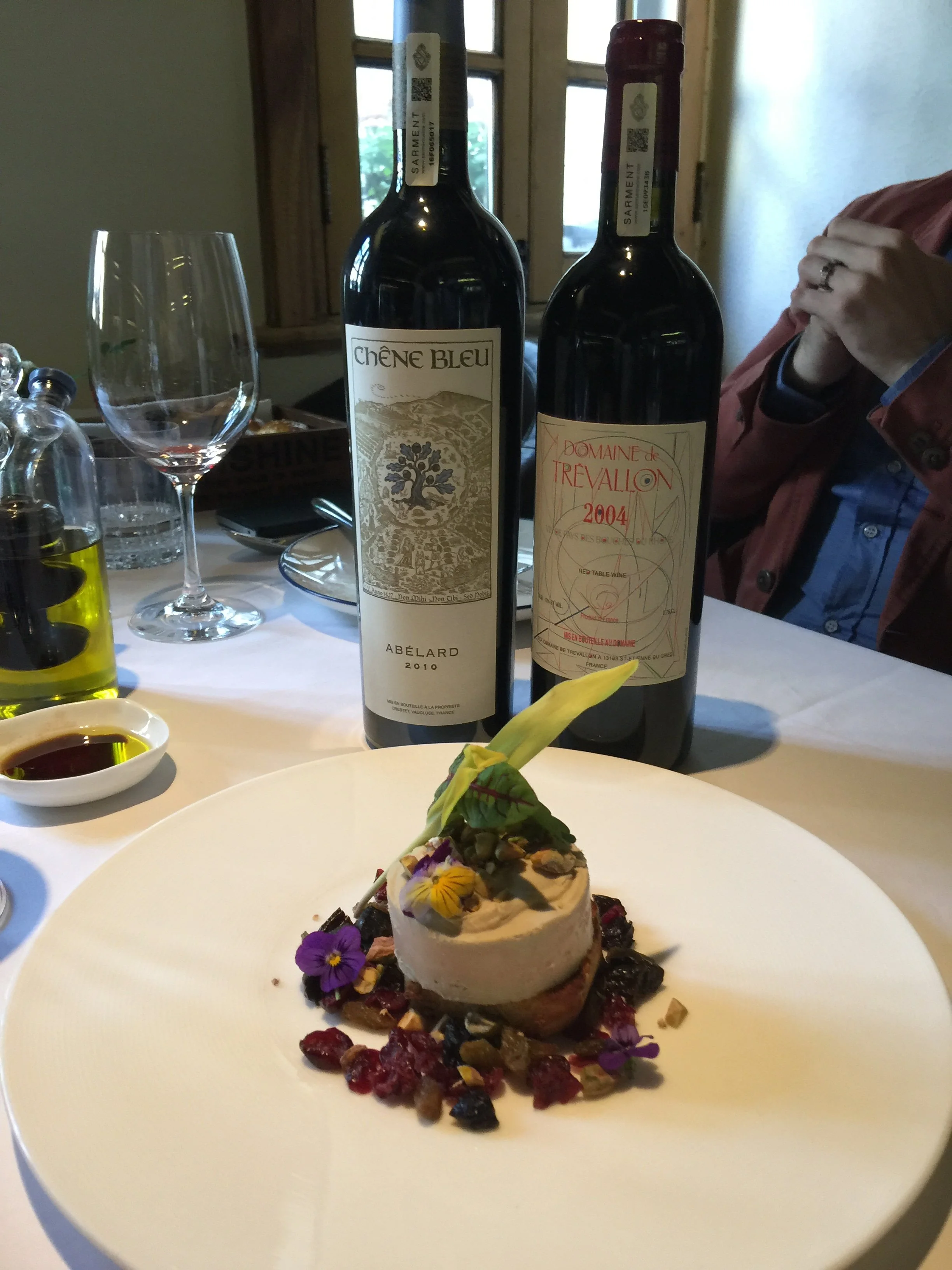
The first winemaker to achieve notoriety on this danger-fraught, lonely, but exciting path, was Eloi Dürrbach (supported by his wife Floriane) at the Domaine de Trevallon. His much-discussed adventure began when had found 18th century references to Cabernet being planted alongside Syrah, which is no longer the tradition in the Provence wine region. Eloi boldly decided to reconnect with this tradition. The wines quickly earned him a reputation and a following that included icon Aubert de Villaine, of Domaine de La Romanée Conti fame, and renowned US importer Kermit Lynch. A well-documented feud with the local appellation resulted in his wines being “downgraded” to Vin de Pays on a what might appear to be a technicality. He defiantly maintained his Cabernet-Syrah blend and his pricing, his martyrdom quickly morphing into to stardom. The Asia trip allowed me to travel around Asia with Eloi and his peppy wife Floriane and get behind-the-scenes blow-by-blow insights into their experiences and opinions.Eloi was not the first to go into Vin de Pays status in order to make wines to his vision of his terroir: other winemakers and estates made the bold move to walk from the appellation system. Names that have become “Grands Classiques” include the dynamic and lovely Guibert family of Mas de Daumas Gassac, who planted a whole host of varieties not typically present in their appellation; Grange des Pères, led by Laurent Vaillé, a former employee of Trevallon, that producing highly sought-after cult wines; Domaine Gauby in the Roussillon- which is further from the Rhone itself but still in proximity to the Rhone Delta.Though very different in backgrounds, motives and styles, these vintners were truly courageous and independently-minded pioneers in what they thought was right for their land terroir. Their courage has inspired a number of other producers to aim high, even if their land or blend is categorised as Vin de pays, Vin de Table or Vin de France. Today other newer producers include Roc d’Anglade, Le Plan Vermeersch, Terres des Amoureuses, and of course Chêne Bleu. It is often pointed out that most of the people that embark on this lonely path are first generation winemakersIt was very interesting when the Wall Street journal, Harpers, and then others decided to name Chêne Bleu the first ‘Super Rhône’, and connect the dots with Trevallon and the others. This was a reference of course to the Super Tuscans, a handful of producers (now icons) who emerged 30 years ago as the first to step out of the appellation system, and nevertheless make world-class wines at Grand Cru prices (Sassicaia, Tignanello, Ornellaia & Masseto followed by myriad of others).There appears to be an increasing understanding and acceptance of the right for winemakers to pursue their convictions and desires for self-definition by making atypical wines, assuming they respect the codes of product safety. However they are identified for legal purposes (VdP, IGP, Vin de Table or Vin de France) or geographic purposes (ie. Super Rhone, Super Sud), in all cases there is a recognition that the wines themselves merit recognition independently of their legal status and even in many cases of their surrounding appellations. As mentioned, and from experience, without the underlying praise for the quality and style of the wine itself, there is no inherent advantage or cachet to being outside the appellation system, quite the contrary—net-net all of us agree that it is a commercial handicap, at least in the first years.In the case of Chêne Bleu, it was the belief that our extreme altitude brings with it opportunities, such as natural freshness, that led to us planting and, above all, blending varieties that would not necessarily achieve the same result in the valley. We consider Chêne Bleu’s warm reception by most world critics a validation of the fact that our wines transmit all the uniqueness of a southern but high-altitude terroir, and we believe this results in an unusual and exciting signature style. In the case of Héloise, things came to a head early on with our decision to include a splash of Viognier in the blend, as in Côte-Rôtie, despite that it’s not allowed in any of the appellations on, or contiguous to, our property: Jean-Louis blended the Syrah and Grenache with and without the Viognier and there was just no question that the former made a better wine: more fragrant, more complex aromatically, and benefitting from nice lift from that elegant, intoxicating hint of perfume that one associates with Northern Rhone, Condrieu-style Viognier. That empirical epiphany, rather than an ideological stance, was the evidence that put us at a fork in the road and led us to leave the appellation. We didn’t fully realise at the time how many extra challenges and opportunities would result from that decision, but looking back we wouldn’t change it for anything, since the resulting freedom of expression fits our broader desire to chart our own course, and design our own wine destiny.Nicole